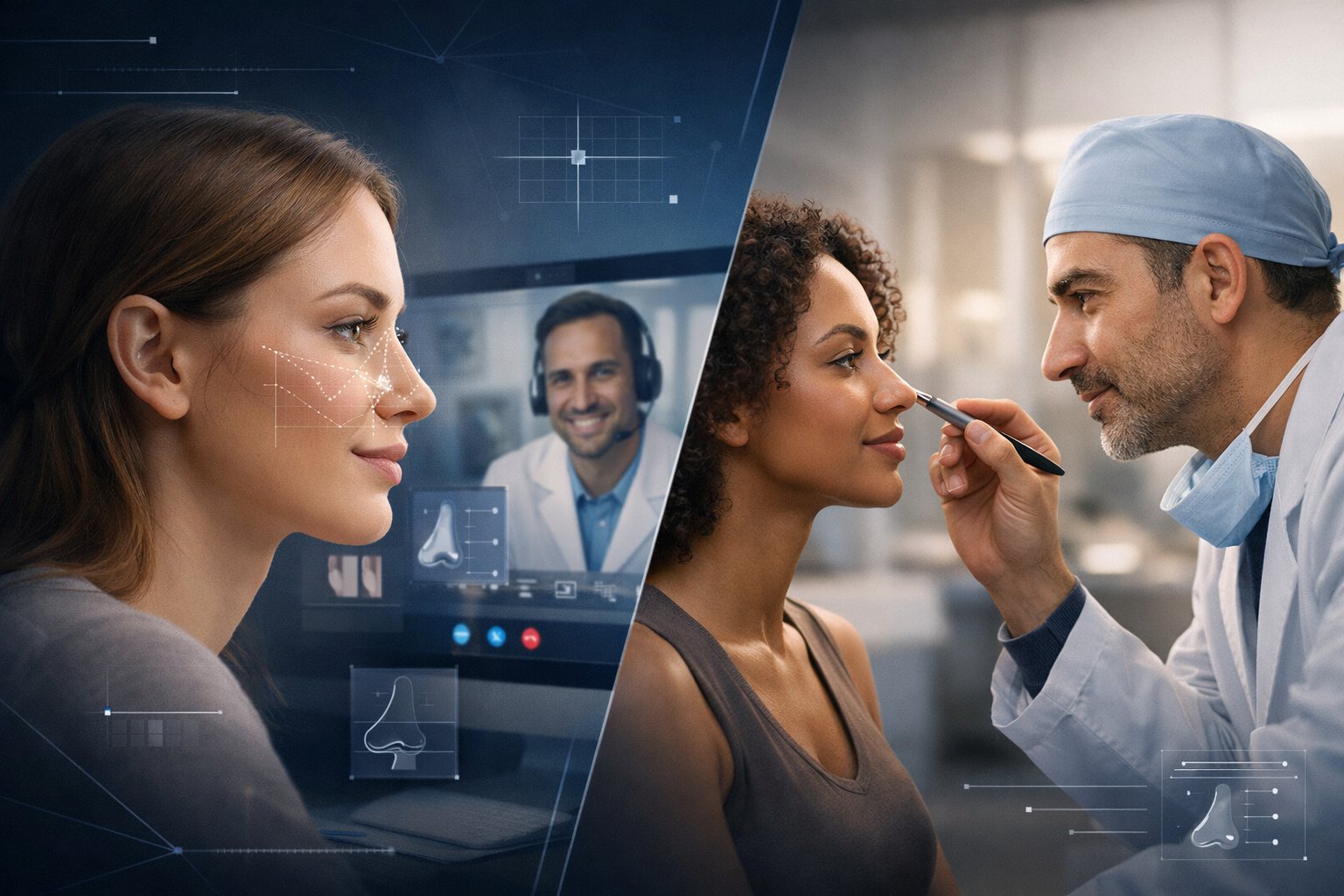
As rhinoplasty becomes more global and technology-driven, many patients face a new question: Is an online consultation enough, or do I still need an in-person visit? For local and international patients alike, the right combination of virtual and face-to-face appointments can save time, reduce travel, and still maintain safety and quality.
This guide explains the advantages and limitations of online consultations, when in-person visits are essential, and how AI-powered platforms like RhinoMatch make both options more effective.
What Is an Online Rhinoplasty Consultation?
An online or virtual rhinoplasty consultation is a remote meeting with a surgeon using:
- Video conferencing tools (Zoom, Meet, clinic platforms)
- Secure messaging and photo uploads
- Sometimes 3D imaging or AI-based facial analysis
It usually includes:
- Review of your photos and medical history
- Discussion of your goals and concerns
- Preliminary evaluation of whether you’re a good candidate
- Basic explanation of techniques, risks, and expected results
- Rough cost estimate and logistics overview
Online consultations are especially popular among international patients considering surgery abroad.
Advantages of Online Rhinoplasty Consultations
Virtual consultations offer several clear benefits—especially at the early research stage.
1. Convenience and Time Savings
- No travel time, parking, or waiting rooms
- Ability to speak with multiple surgeons in different cities or countries within a few days
- Flexible scheduling across time zones
This is ideal if you're trying to compare several rhinoplasty surgeons before committing to travel.
2. Access to Top Surgeons Worldwide
Online consultations remove geographic limits. You can:
- Speak with surgeons in different countries known for rhinoplasty expertise
- Compare options in Turkey, the US, Europe, or Korea without leaving home
- Find surgeons who specialize in your anatomy and goals, not just those close to you
For many patients, this opens the door to higher-quality care at better prices, especially in medical tourism destinations.
3. Lower Initial Costs
Many surgeons offer:
- Free or low-cost initial virtual consultations
- Package pricing for international patients that includes virtual follow-up
This allows you to filter out surgeons who aren’t a good fit before spending money on travel or booking fees.
4. Better Preparation and Communication
Online consultations often go hand-in-hand with:
- Photo-based analysis and morphing simulations
- Written summaries of the discussion
- Digital consent forms and information packs
When integrated with AI tools like RhinoMatch, surgeons can review structured anatomical analysis and portfolio matches before they even meet you online, making the conversation more focused and personalized.
Limitations of Online Consultations
Despite their benefits, virtual consultations have real limitations—especially for complex or high-risk cases.
1. No Physical Examination
In rhinoplasty, touch matters. Surgeons assess:
- Skin thickness and texture
- Cartilage strength and flexibility
- Internal structural issues (septal deviation, valve collapse, turbinate size)
While some of this can be inferred from photos and scans, a full, detailed nasal exam usually requires in-person contact and tools like nasal endoscopy.
2. Limited Assessment of Breathing Function
Breathing problems are a major component of many rhinoplasty cases. Online, a surgeon can ask questions such as:
- “Which side feels blocked?”
- “Do you snore or mouth-breathe?”
- “Have you tried nasal sprays or previous treatments?”
But they cannot directly test airflow, observe dynamic valve collapse, or perform endoscopic exams through video alone. For functional rhinoplasty, an in-person exam is usually required before final surgical planning.
3. Camera and Lighting Limitations
Consumer webcams and smartphone cameras can distort:
- Proportions and angles
- Skin quality and fine surface irregularities
- Subtle asymmetries
High-quality photos with clear instructions can reduce these issues, but they rarely replace professional imaging in the clinic.
Advantages of In-Person Consultations
Face-to-face consultations remain the gold standard for final decision-making and surgical planning.
1. Detailed Physical and Internal Examination
In person, your surgeon can:
- Palpate the nasal bones and cartilage
- Assess skin thickness directly
- Perform internal nasal examination and endoscopy if needed
- Evaluate breathing in real time
This information is essential to design a safe, effective surgical plan—especially if you have trauma history, prior surgery, or functional complaints.
2. More Precise Imaging and Simulations
Many clinics use:
- Professional photography in standardized lighting and angles
- 3D imaging and morphing software
- CT scans for complex functional or revision cases
These tools allow much more accurate planning than what is possible with casual photos taken at home.
3. Stronger Trust and Rapport
Meeting in person helps you evaluate:
- The surgeon’s body language and confidence
- Clinic environment and hygiene
- How staff treat you and other patients
Since rhinoplasty is a deeply personal procedure, feeling genuinely comfortable and understood by your surgeon is crucial.
The Hybrid Approach: Best of Both Worlds
For many patients—especially international ones—the most effective path is a hybrid model that combines online and in-person consultations.
Example hybrid path:
- Step 1: Use RhinoMatch to identify high-match surgeons based on your anatomy, goals, and budget.
- Step 2: Book online consultations with your top 2–3 surgeons.
- Step 3: Compare communication style, proposed techniques, and expectations.
- Step 4: Travel to your chosen surgeon for an in-person exam and final surgical planning.
- Step 5: Combine in-person post-op visits with scheduled online follow-ups once you return home.
This blended strategy maximizes both convenience and safety.
Special Considerations for International Patients
If you’re considering rhinoplasty abroad—for example, in Turkey or another medical tourism destination—the online vs in-person question is even more important.
Online Consultation Benefits for Medical Tourism
- Compare surgeons and clinics without multiple trips
- Receive detailed package quotes and recovery timelines
- Clarify how many days you must stay in the country
- Discuss realistic expectations before booking flights
Countries with strong medical tourism sectors often structure their workflow around this hybrid model, making remote planning smoother.
In-Person Timing for International Cases
For international patients, common timing strategies include:
- Arriving 1–3 days before surgery for pre-op exams, labs, and final planning
- Staying 7–10 days after surgery for splint removal and early checks
- Completing later follow-ups via video calls and photo submissions
Ask your surgeon exactly how many in-person visits are mandatory and whether they offer structured online follow-up for long-distance patients.
How RhinoMatch Enhances Both Online and In-Person Consultations
RhinoMatch improves the quality of consultations by providing your surgeon with:
- AI-based analysis of your nasal anatomy before the meeting
- Classification of your case complexity (minor refinement, major reconstruction, revision, functional+aesthetic)
- Sample before-and-after cases from the surgeon’s portfolio that match your anatomy
- Structured summary of your goals and concerns
This allows the surgeon to arrive at the consultation—online or in person—already familiar with your nose and focused on solutions rather than basic screening.
When Is Online Consultation Enough?
An online consultation can be sufficient for initial screening and shortlisting surgeons when:
- You are still in the research phase
- Your case seems straightforward (minor hump, small tip refinement, no major breathing issues)
- You want to compare different philosophies and aesthetic styles
- You are not yet ready to commit to a specific surgeon or travel plan
However, even in simpler cases, final green light for surgery should follow an in-person physical examination.
When Is In-Person Consultation Essential?
A full in-person evaluation is especially important when you have:
- Significant breathing problems
- History of nasal trauma
- Previous rhinoplasty (revision case)
- Complex deformities or severe deviation
- Medical conditions that increase surgical risk
In these situations, online consultations are useful for orientation—but not enough to replace a thorough hands-on exam.
Practical Checklist: Choosing Your Consultation Strategy
Before deciding how to proceed, ask yourself:
- ☑ Do I want to compare several surgeons before choosing one?
- ☑ Am I considering surgery abroad and want clarity on packages and timelines?
- ☑ Do I have complex anatomy or previous surgeries that demand in-depth physical assessment?
- ☑ Does the surgeon offer a structured hybrid pathway (online + in-person)?
- ☑ Can the clinic support online follow-up once I return home?
Final Thoughts: Combine Technology with Human Expertise
Online consultations are a powerful tool, but they should complement—not replace—expert in-person evaluation. With platforms like RhinoMatch, you can intelligently pre-select surgeons, prepare for your consultations with data-driven insights, and use both virtual and face-to-face visits to build a safe, personalized rhinoplasty plan.
Use technology to expand your options and refine your choices—then rely on a thorough physical examination and your own intuition to make the final decision.