Understanding Nasal Deviation
A deviated or crooked nose represents one of the most challenging conditions in rhinoplasty, affecting both aesthetic appearance and nasal function. Unlike a simple dorsal hump or bulbous tip—localized concerns—nasal deviation involves asymmetry throughout the entire nasal structure from root to tip, often with internal septal deviation causing breathing obstruction. This complexity requires comprehensive surgical planning addressing both external appearance and internal airway function.
Nasal deviation presents in several distinct patterns: C-shaped deviation where the entire nose curves to one side in a smooth arc, S-shaped deviation with the nose curving one direction in the upper portion and the opposite direction lower down, creating an S-curve, linear tilt where the nose tilts to one side without actual curvature, maintaining straight dorsal lines but off the facial midline, and localized deviation affecting only specific regions such as the tip, middle vault, or bony pyramid while other areas remain straight. Understanding your specific deviation pattern guides appropriate correction strategies.
Causes of Nasal Deviation
Nasal deviations develop through multiple mechanisms, each influencing the surgical approach. Trauma represents the most common cause—nasal fractures from sports injuries, accidents, or physical altercations break nasal bones and disrupt septal cartilage. Even childhood trauma, seemingly insignificant at the time, can produce deviations that become apparent as the nose develops through adolescence.
Developmental factors create many deviations as well. Asymmetric growth during adolescence can produce septal deviation that pulls the external nose off-center. Birth trauma, particularly difficult deliveries or breech presentations, sometimes injures the infant's nose creating deviations that manifest years later. Congenital factors—genetic predisposition and familial patterns—produce crooked noses that run in families despite no history of trauma.
Previous surgery can cause or worsen deviation. Aggressive reduction rhinoplasty sometimes destabilizes the nasal framework, allowing asymmetric collapse or twisting during healing. Incomplete correction during initial surgery leaves residual deviation. Asymmetric scar contracture pulls structures off-center as healing progresses.
Tumors or masses, though rare, can produce deviation by displacing nasal structures. These typically present with additional symptoms beyond simple crookedness—obstruction, epistaxis (nosebleeds), or visible masses—prompting imaging studies that reveal the underlying cause.
The Internal Component: Septal Deviation
External nasal deviation almost always accompanies internal septal deviation—crookedness of the cartilage and bone dividing the nasal cavity into right and left chambers. The septum comprises several components: quadrangular cartilage anteriorly, perpendicular plate of ethmoid bone superiorly, vomer bone posteriorly, and maxillary crest inferiorly. Deviation can affect any or all of these components, creating complex three-dimensional deformity.
Septal deviations manifest in various patterns: caudal deviation affects the front portion of the septum visible at the nasal base, causing obvious external asymmetry. Dorsal deviation affects the portion supporting the nasal bridge, causing the external nose to deviate in the same direction. Posterior deviation affects the back portion near the nasopharynx, potentially causing less external asymmetry but significant breathing obstruction. High septal deviation affects the superior septum near the skull base, sometimes causing asymmetric appearance without major breathing impact. Compound deviations involve multiple regions creating complex three-dimensional deformity requiring sophisticated correction techniques.
The septum's anatomical relationships explain why internal deviation produces external crookedness. The septum connects to and supports the nasal bones superiorly, the upper lateral cartilages laterally, and the lower lateral cartilages inferiorly. When the septum deviates, it pulls or pushes these connected structures off-center, creating visible external asymmetry. Conversely, fractures or deviation of the bony pyramid can buckle or displace the septum, creating internal airway obstruction.
This interdependence means that addressing only external deviation without correcting the septum typically fails, as the deviated septum continues pulling the external structure off-center. Similarly, septoplasty alone (correcting only the internal septum) may improve breathing but leave external crookedness unchanged. Comprehensive correction requires simultaneous internal and external work—septorhinoplasty.
Functional Impact: Breathing Obstruction
Beyond cosmetic concerns, nasal deviation significantly impacts breathing. The deviated septum narrows or blocks one or both nasal passages, forcing obligate mouth breathing particularly during sleep or exercise. The compensatory hypertrophy that often develops—enlargement of turbinates on the side opposite the deviation—further compromises the airway. This hypertrophy represents the body's attempt to balance airflow between sides, but ironically creates additional obstruction.
Internal valve compromise represents another functional consequence. The internal nasal valve—the angle between septum and upper lateral cartilage—represents the narrowest portion of the nasal airway. Septal deviation can narrow this critical valve, producing the sensation of obstruction even when the passages themselves are patent. External valve dysfunction may accompany deviation, particularly in revision cases or after trauma, where sidewall weakness causes inspiratory collapse—the nostrils suck inward during inhalation, blocking airflow.
Chronic nasal obstruction triggers cascading problems: sleep disruption including snoring, sleep apnea, or restless sleep from mouth breathing, exercise limitation with inability to breathe adequately through the nose during physical activity, chronic sinus issues as blocked drainage pathways promote sinusitis, dry mouth and throat from chronic mouth breathing, and headaches sometimes resulting from altered airflow patterns and sinus drainage. These functional impairments often motivate surgery as much as or more than cosmetic concerns, making comprehensive functional restoration crucial to patient satisfaction.
Aesthetic Implications: External Appearance
The aesthetic impact of nasal deviation extends beyond obvious crookedness. Facial asymmetry becomes more apparent as the off-center nose draws attention to underlying facial asymmetries most people have. Proportional imbalance occurs as deviation creates unequal nasal widths, nostril sizes, or tip positions that disrupt facial harmony. Profile irregularities develop where deviation creates bumps or hollows along the nasal bridge. Tip asymmetry results from caudal septal deviation or asymmetric lower lateral cartilages pulling the tip off-center.
These aesthetic concerns often prove psychologically significant. Multiple studies demonstrate that facial symmetry correlates with perceived attractiveness, and the central nose's position makes its asymmetry particularly noticeable. Patients frequently report self-consciousness in photographs, particularly profile views, avoidance of certain angles or lighting that emphasize crookedness, and dissatisfaction with overall facial appearance disproportionate to the actual degree of deviation—a slightly crooked nose becomes the focus of appearance-related distress.
Surgical Correction: Septorhinoplasty Principles
Correcting nasal deviation requires septorhinoplasty—combined septal straightening and external nasal realignment. This comprehensive approach addresses internal and external components simultaneously, creating functional improvement and aesthetic straightening. The fundamental principle involves releasing existing attachments that maintain deviation, straightening or replacing deviated structures, and stabilizing the corrected position with grafts and sutures.
Surgical planning begins with detailed analysis identifying the specific deviation pattern using physical examination, nasal endoscopy to assess internal septum and turbinates, and CT scanning for complex deviations or revision cases showing bone and cartilage relationships. This analysis determines which structures require correction and what techniques will achieve optimal results.
The surgery typically proceeds through systematic steps: septal correction forming the foundation by creating a straight central support structure, bony pyramid realignment using osteotomies if the nasal bones are deviated, middle vault reconstruction addressing asymmetric upper lateral cartilages, tip realignment correcting asymmetric lower lateral cartilages, and grafting and suturing to stabilize all corrected structures in proper position. Each step builds upon the previous one, with the straightened septum serving as the central reference point for external alignment.
Septal Correction Techniques
Septoplasty in the context of deviation correction differs from routine septoplasty for simple breathing improvement. Deviations often involve severe angulation, dislocation from the maxillary crest, or complex three-dimensional bending requiring sophisticated correction techniques beyond simple resection of deviated portions.
Scoring and suturing involves making multiple partial-thickness cuts on the concave side of deviated cartilage, weakening the cartilage so it can be straightened, then securing the straightened cartilage with internal sutures. This technique works well for moderately deviated cartilage that retains intrinsic straightness but has been bent into an abnormal position.
Resection and replacement involves removing severely deviated cartilage that cannot be straightened, carving replacement pieces from the removed cartilage, and reimplanting these straight pieces secured to remaining stable framework. This technique suits severely deviated cartilage with permanent deformation resistant to scoring.
Extracorporeal septoplasty represents the most aggressive approach: the entire septum is removed from the nose, taken to the surgical back table where it's completely reconstructed with all deviations corrected, and reimplanted as a straight structure secured in proper position. This technique reserves for the most severe deviations or revision cases where prior surgery has created complex distortion.
Spreader grafts serve multiple functions in deviation correction beyond valve support. They help camouflage residual dorsal septal deviation by creating symmetric dorsal aesthetic lines even if minimal underlying asymmetry persists, provide structural support preventing recurrent deviation, widen the middle vault improving breathing, and create symmetric framework even when underlying septum has minor persistent irregularity.
Batten grafts are placed along the caudal septum, providing structural reinforcement that prevents recurrent deviation of this critical region. The caudal septum—the front portion visible at the nasal base—is particularly prone to persistent or recurrent deviation, as it lacks bone support and must resist forces from tip cartilages. Batten grafts carved from ear or septal cartilage provide necessary stiffness maintaining straight position.
Bony Pyramid Correction
When the nasal bones themselves are deviated—from trauma, prior surgery, or developmental factors—septoplasty alone proves insufficient. The bony pyramid must be mobilized and repositioned through osteotomies. These controlled fractures allow surgeons to move the nasal bones into proper symmetric position relative to the midline.
The technique involves lateral osteotomies creating controlled fracture lines along the junction of nasal bones with maxilla, medial oblique osteotomies releasing the nasal bones from their attachment to the septum, and mobilization allowing the freed bone segments to be repositioned. For deviated noses, asymmetric osteotomies are often employed—more extensive bone release on the side toward which the bones are deviated, less extensive on the opposite side. This asymmetric technique facilitates moving the bones back toward midline.
In complex or post-traumatic deviations, additional techniques include intermediate osteotomies creating additional fracture lines for better control, transverse osteotomies at the radix allowing repositioning of the entire bony pyramid, and bone grafting filling gaps or asymmetries that develop after repositioning. Severe bony deviation sometimes requires removing segments of deviated bone entirely, rather than repositioning, then grafting to recreate symmetric contour.
Middle Vault and Tip Realignment
The middle vault—the cartilaginous middle third of the nose formed by the upper lateral cartilages—often displays asymmetry in deviated noses. One upper lateral cartilage may be longer, wider, or differently positioned than its counterpart, contributing to visible crookedness. Correction involves careful assessment of asymmetry, strategic trimming or augmentation to balance the upper lateral cartilages, spreader grafts creating symmetric dorsal lines, and suturing techniques securing cartilages in symmetric position relative to the now-straightened septum.
Tip deviation, particularly common with caudal septal deviation, requires specific correction techniques. The caudal septum forms the foundation for tip position—when it deviates, the entire tip follows. Correction involves straightening the caudal septum as described previously, repositioning the medial crura (the cartilages forming the columella) into symmetric position, and tongue-in-groove technique where the medial crura are secured directly to the caudal septum, preventing recurrent tip deviation. Columellar strut grafts may provide additional support, particularly in revision cases where natural support structures have been compromised.
Turbinate Management
As noted earlier, septal deviation often causes compensatory turbinate hypertrophy on the side opposite the deviation. After correcting the septum, this enlarged turbinate may continue obstructing airflow despite the newly created space. Turbinate reduction, performed simultaneously with septorhinoplasty, addresses this issue through several techniques.
Submucosal reduction preserves the turbinate's mucosal covering while removing bone and soft tissue bulk internally. This technique maintains the turbinate's normal humidification and filtering functions while reducing its size. Radiofrequency ablation uses thermal energy to shrink turbinate tissue with minimal bleeding. Partial turbinectomy removes the posterior portion of the turbinate in cases of severe hypertrophy, though this more aggressive approach carries higher risk of empty nose syndrome if performed too extensively. Out-fracture simply fractures the turbinate laterally, displacing it away from the septum and increasing the nasal passage width without actually removing tissue.
The choice of technique depends on turbinate size, patient symptoms, and surgical philosophy. Conservative approaches (radiofrequency, submucous reduction) are favored initially, reserving more aggressive techniques for severe cases unresponsive to conservative measures.
Grafting for Stabilization and Camouflage
Even after meticulous septal, bony, and cartilaginous correction, grafts often prove necessary for stabilizing structures in corrected positions and camouflaging residual minor asymmetries. Spreader grafts and batten grafts have been discussed, but additional grafting includes dorsal onlay grafts bridging across minor residual irregularities and creating perfectly straight dorsal lines visible externally, alar contour grafts correcting asymmetry of the nostril rims or alar sidewalls, and cap or shield grafts on the tip providing symmetric contour if tip cartilages remain slightly asymmetric despite surgical repositioning.
These refinement grafts serve aesthetic and functional purposes simultaneously—creating visible symmetry while providing structural support that prevents recurrent deviation during healing. The extensive grafting common in deviation correction contrasts with routine rhinoplasty where grafts may be minimal or unnecessary, reflecting the complexity of achieving and maintaining straight position in noses with inherent asymmetric forces.
The Challenge of Recurrent Deviation
One sobering reality of deviation correction is the risk of recurrent crookedness. Despite meticulous surgical technique, deviated noses sometimes drift back toward their original position during healing, particularly in the first 6-12 months post-surgery. This recurrence stems from several factors: memory in cartilage, where even straightened cartilage retains tendency to return to its deformed shape, asymmetric scar contracture where unequal scarring pulls structures off-center, incomplete initial correction where subtle deviations persist allowing forces that produce recurrence, and revision surgery cases where previous scarring and structural weakness increase instability.
Techniques to minimize recurrence include aggressive release of all restricting attachments during initial surgery, extensive grafting providing mechanical support against deviating forces, prolonged splinting keeping the nose in corrected position during early healing, internal sutures maintaining septal position for months until tissues stabilize, and camouflage grafts creating appearance of straightness even if minimal underlying asymmetry persists. Despite these measures, some recurrence may occur, particularly in complex or revision cases, making patient counseling about this possibility important during preoperative discussions.
Realistic Expectations and Surgical Limitations
Achieving perfect straightness in severely deviated noses represents one of rhinoplasty's greatest challenges. Patients must understand realistic limitations: perfect symmetry may be unattainable, particularly in severe or post-traumatic deviations. Improvement rather than perfection represents success, with the goal being straight appearance from normal viewing distances even if minor asymmetries persist on close examination. Some compromise between straightness and other goals (breathing, stability, avoiding over-surgery) may be necessary. Multiple stages might be required for optimal results in extreme cases, with initial surgery creating major improvement and subsequent revision addressing residual concerns after tissues heal and stabilize.
These limitations don't represent surgical failure but rather anatomical reality. Crooked noses involve complex three-dimensional deformity with inherent forces promoting asymmetry. Creating and maintaining straightness against these forces challenges even the most skilled surgeons. Honest preoperative discussion about what's achievable prevents postoperative disappointment and establishes appropriate goals.
The Role of Computer Imaging
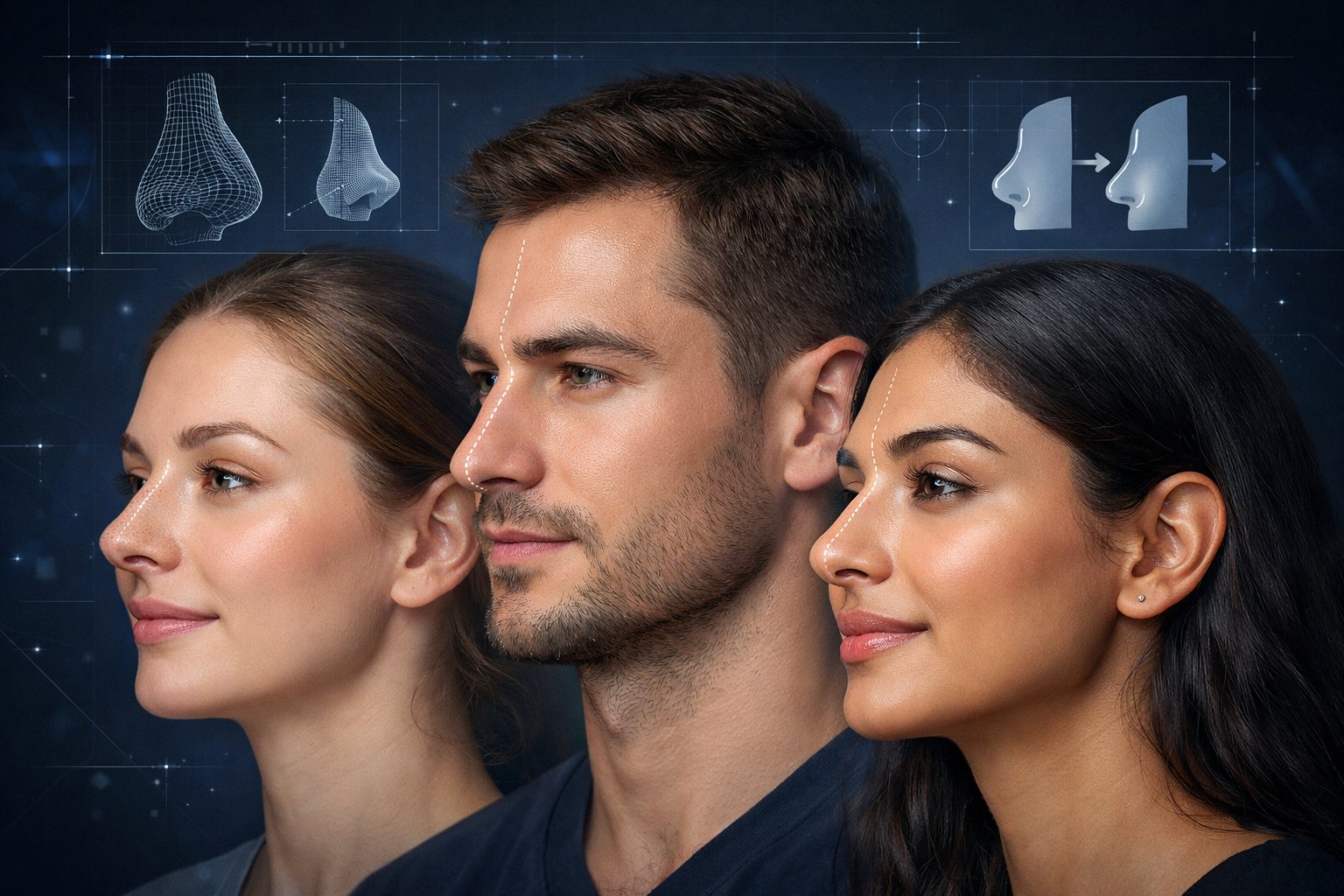
Computer imaging proves particularly valuable for deviation correction consultations. Three-dimensional imaging systems can show the face with the nose straightened, allowing patients to visualize potential outcomes, demonstrate how straightening impacts overall facial appearance and harmony, identify if additional procedures (chin augmentation, facial asymmetry correction) would enhance results, and set realistic expectations by showing achievable versus idealized outcomes.
These simulations don't represent guaranteed results but help communicate surgical goals and limitations. Patients frequently realize through imaging that perfectly straight noses may actually look odd on their face, and that subtle straightening creating harmony produces better aesthetic outcomes than aggressive correction seeking perfect symmetry.
Revision Septorhinoplasty for Persistent Deviation
When deviation persists or recurs after initial surgery, revision septorhinoplasty becomes necessary. Revision cases present additional challenges: scar tissue distorts anatomy making dissection more difficult, cartilage supply may be limited if septum and ear were extensively harvested initially, tissue quality is often compromised from previous surgery, and patient psychology may be fragile after disappointment with initial results.
Successful revision requires identifying what was missed or inadequately addressed initially, planning more aggressive correction given the tendency toward recurrence, potentially using rib cartilage for extensive grafting if autologous cartilage supply is depleted, and sometimes staging procedures to allow tissue recovery between stages. Surgeons specializing in revision rhinoplasty develop expertise managing these complex cases, employing advanced techniques and extensive grafting to achieve outcomes that eluded initial surgery.
Choosing Your Deviation Correction Specialist
Given the complexity of deviation correction, surgeon selection proves critical. Seek surgeons with extensive septorhinoplasty experience, specific portfolio demonstrating successful deviation correction, understanding of both functional and aesthetic goals, and experience with revision cases if you've had previous surgery. During consultations, assess if the surgeon carefully analyzes your specific deviation pattern, explains their planned approach addressing both internal and external components, shows realistic expectations including potential limitations, and demonstrates revision experience if you're considering secondary surgery.
AI-powered matching platforms can identify surgeons specializing in deviation correction, filtering by functional rhinoplasty expertise, revision surgery experience, and outcomes in crooked nose cases similar to yours, streamlining your search for the right specialist.
Conclusion: Comprehensive Correction for Lasting Results
Nasal deviation represents one of rhinoplasty's most challenging scenarios, requiring comprehensive surgical planning, meticulous technical execution, and realistic expectations. When addressed through skilled septorhinoplasty combining internal septal correction with external realignment, most patients achieve significant improvement in both appearance and breathing. While perfection may be elusive and some compromise inevitable, modern techniques offer hope for meaningful enhancement that restores facial harmony, improves quality of life through better breathing, and provides psychological benefits from correcting a long-standing concern. Your journey toward a straighter nose begins with thorough evaluation by an experienced surgeon who understands the complexities of deviation correction and commits to pursuing optimal outcomes within anatomical realities.