Many rhinoplasty patients are eager to return to makeup as soon as possible, especially to cover bruising and swelling around the eyes. However, applying products too early or with too much pressure can irritate incisions, increase infection risk, or slow healing.[web:62][web:60] This guide explains when it is usually safe to wear makeup after a nose job and how to do it gently and effectively.
When Can You Start Wearing Makeup Again?
The exact timing depends on the surgical technique (open vs. closed rhinoplasty), your skin type, and your surgeon’s preferences, but some general patterns appear across clinical recommendations.
- >First week: Most surgeons advise avoiding makeup on or near the nose while splints, bandages, or external stitches are present.[web:60][web:64]>Closed rhinoplasty: Light makeup away from incisions is sometimes allowed about 1 week after surgery, once splints and casts are removed, with extreme gentleness around the nose.[web:62]>Open rhinoplasty: Because there is an external incision on the columella, many surgeons prefer that patients wait around 2–4 weeks before applying makeup near that area.[web:62][web:63]>Non-surgical nose job: Since there are no incisions, concealer or foundation is often permitted after 24 hours, as long as there is no pressure on the treated area.[web:62]
Some surgeons in aesthetic and facial plastic practices suggest a conservative window of about 1–2 weeks before applying makeup around the nose, then extending or shortening that timeframe based on individual healing.[web:64][web:63]
Principles for Safe Post-Rhinoplasty Makeup
Regardless of when you restart, a few universal rules make makeup safer after nasal surgery:
- >No pressure on incisions or the nasal bridge: Use feather-light motions and avoid buffing, dragging, or pressing brushes and sponges into the skin.[web:62][web:60]>Keep at least 1 cm away from fresh stitches: Concealer can disguise bruising, but it should not touch suture lines.[web:62]>Choose hypoallergenic, non-comedogenic products: Lightweight, breathable formulas are less likely to clog pores or trigger irritation on stressed skin.[web:62][web:63]>Prioritize cleanliness: Brushes and sponges must be thoroughly cleaned to reduce bacterial contamination and infection risk.[web:62]
Step-by-Step: First Safe Makeup Application
Once your surgeon gives you the green light, you can follow these steps to apply makeup while still respecting the healing process.
1. Gentle Cleansing and Skin Prep
Use a mild, fragrance-free cleanser, carefully avoiding excessive rubbing around the nose and incision sites.[web:62] Pat your face dry with a soft towel rather than rubbing. Apply a light, non-irritating moisturizer, staying away from sutures and any open or crusted areas.
2. Color Correcting Bruises
Bruises around the eyes and upper cheeks are common after rhinoplasty and can last 1–2 weeks or longer.[web:17][web:14] To neutralize their color:
- >Use a peach or salmon corrector for bluish or purple under-eye bruises.>Use a yellow-toned corrector for more greenish areas.
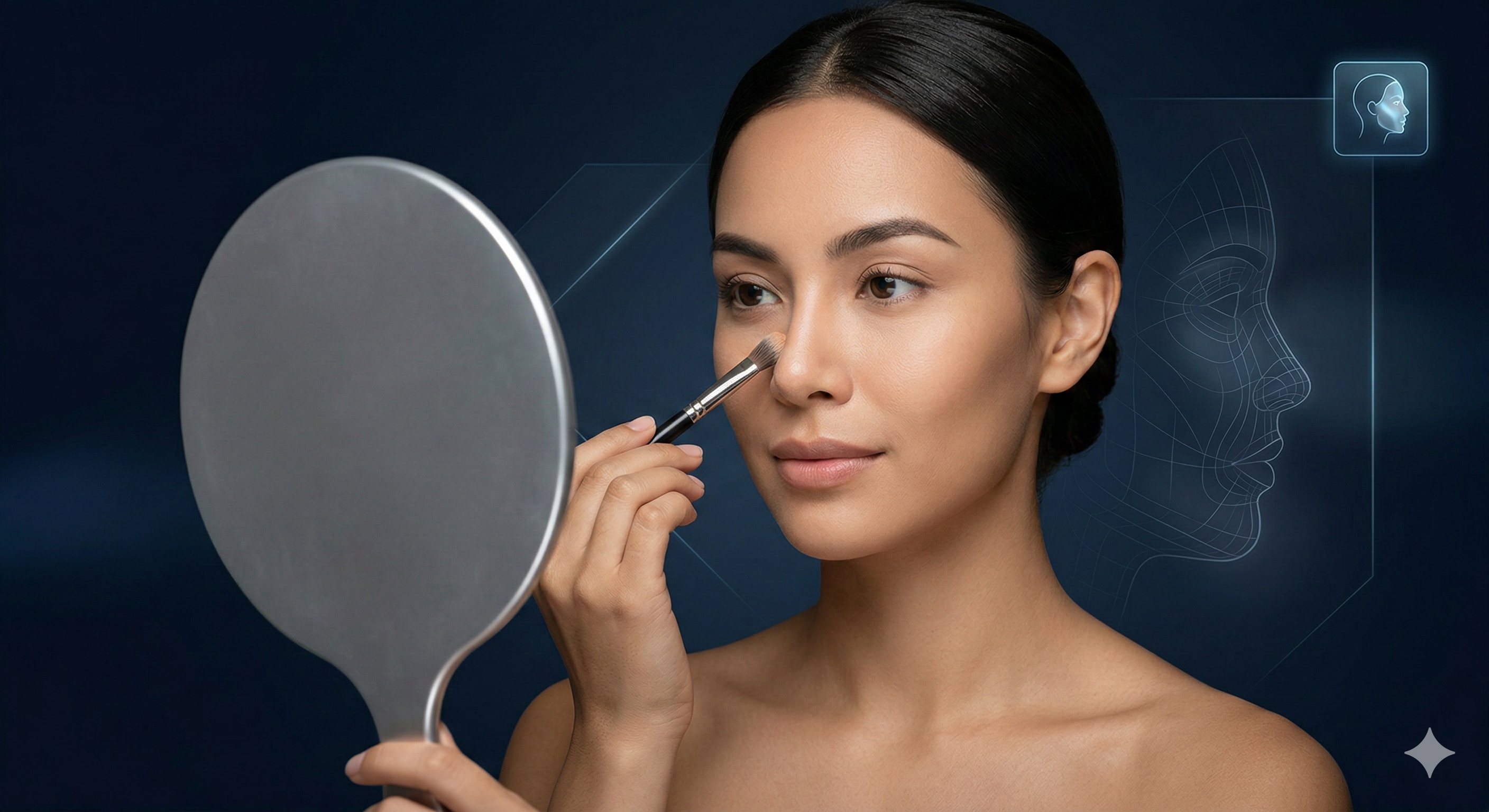
Tap the product in gently with a clean fingertip or soft sponge, keeping it a safe distance from incision lines.[web:62]
3. Applying Lightweight Base Makeup
Opt for a sheer, hydrating foundation or tinted moisturizer rather than a heavy, full-coverage formula, which can look cakey on swelling and increase pore blockage.[web:62][web:70]
- >Dot a small amount of product on the forehead, cheeks, and chin—avoid placing it directly over the nose if your surgeon has advised against it.>Use a damp sponge or soft brush to blend with tapping motions, not dragging or buffing.[web:60][web:67]
If your surgeon permits foundation over the nose later in recovery, continue to use minimal amounts and the lightest possible touch.
4. Targeted Concealer for Extra Coverage
After foundation, use a concealer that matches your skin tone to spot-cover any remaining discoloration.
- >Apply tiny dots under the eyes or on residual bruises.>Blend by tapping outward with a fingertip or soft sponge, again staying slightly away from incision lines and the most sensitive areas around the bridge and tip.[web:62]
5. Eye Makeup and Brows
Eye makeup is often allowed somewhat earlier than nasal makeup, but you still need to be careful not to bump the nose when removing it.
- >Mascara, eyeliner, and eyeshadow are generally safe to use after about a week, provided you avoid pressing against the nasal bridge when cleansing.[web:62][web:63]>Use oil-free, easy-to-remove products and take your time with cotton pads or reusable cloths so you do not accidentally hit the nose splint or healing tissues.[web:62]
Product Types to Prefer and Avoid
Product choice can make a big difference in how your skin tolerates makeup during recovery.
- >Prefer: Mineral-based or hypoallergenic foundations, fragrance-free moisturizers, hydrating concealers, and non-comedogenic powders applied only where necessary.[web:62][web:67]>Avoid for the first months: Very heavy, long-wear or full-coverage foundations that require vigorous rubbing to remove; products with strong perfumes or potential irritants.[web:62][web:63]
For some patients, surgeons recommend skipping foundation entirely for up to 2 months on the nose itself, relying instead on light concealer and eye-focused looks to draw attention away from residual swelling.[web:62][web:64]
Removing Makeup Without Harming Your Result
Even more important than application is how you remove your makeup at the end of the day.
- >Use a gentle, non-foaming cleanser or micellar water on cotton pads to dissolve products without scrubbing.[web:62]>Cleansing motions should move outward and downward on the cheeks and forehead, with minimal contact over the nasal bridge.>Pat dry with a soft towel and reapply a soothing, surgeon-approved moisturizer, steering clear of healing incisions.
How Nose Journey Helps You Align Aesthetics and Safety
The best makeup results start with a well-executed surgery. Nose Journey uses AI to match you with rhinoplasty surgeons whose portfolios, techniques, and communication style align with your aesthetic goals and lifestyle, including how quickly you want to return to daily routines like makeup.[memory:3]
By combining the right surgeon with the careful, step-by-step approach in this guide, you can look polished during recovery without compromising your long-term outcome.