Instagram vs Real Life: How Social Media Shapes Rhinoplasty Expectations
Platforms like Instagram, Snapchat, and TikTok have changed the way we see our faces. Filters slim noses, smooth skin, and sharpen jawlines in seconds. While these tools can be fun, they also influence how people think they “should” look—and increasingly drive the decision to have rhinoplasty. Understanding the gap between filtered images and real-life anatomy is essential for healthy expectations and safe cosmetic decisions.
Filters vs. Real Results: Two Different Worlds
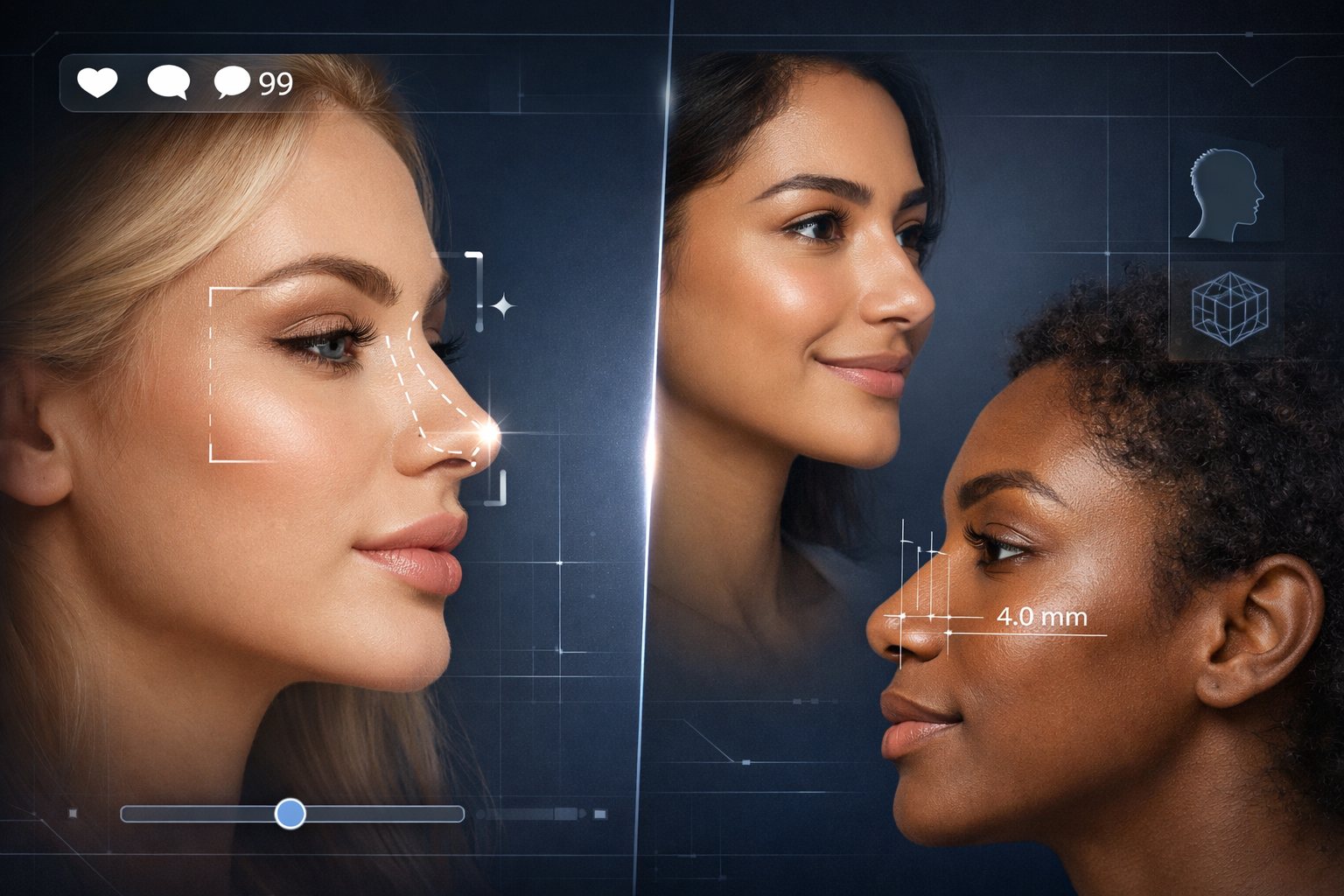
Advanced filters can create features that are not anatomically realistic: extremely narrow bridges, perfectly symmetrical nostrils, poreless skin, and exaggerated tip rotation. Medical research notes that social media filters often promote a very narrow, homogeneous standard of beauty emphasizing slimmer noses, bigger eyes, sharp jaws, and flawless skin.[web:58][web:39]
These “digital noses” are not constrained by cartilage strength, skin thickness, or breathing function. Surgery, however, must respect all of these factors. This is why trying to match a filter exactly is not only unrealistic but also potentially unsafe.
How Social Media Influences the Decision to Have Rhinoplasty
Several studies highlight the powerful role of social media and celebrity content in rhinoplasty decision‑making. Cross‑sectional surveys from Saudi Arabia found that more than a quarter of respondents felt social media celebrities influenced their choice to undergo rhinoplasty.[web:53][web:50] Before–after photos shared by influencers and clinics also act as strong motivators.[web:53]
Another study on adults in the western and southern regions of Saudi Arabia showed that platforms like Snapchat and Instagram were among the most influential, especially when procedures were promoted by trusted figures or celebrities.[web:49][web:53] These findings confirm what many surgeons see daily: patients arrive with screenshots and filtered selfies, expecting surgery to reproduce these images.
Snapchat Dysmorphia and Social Media Dysmorphia
The term “Snapchat dysmorphia” describes a growing trend where people want to look like their filtered selfies in real life. Clinicians report that social media filters significantly influence patient expectations and are associated with higher rates of body dysmorphic disorder (BDD) and revision requests.[web:58][web:39]
Warning signs of social media–driven dysmorphia include:[web:58][web:39][web:61]
- Spending long periods editing selfies and feeling distressed by unfiltered photos
- Bringing heavily filtered images to consultations as the main reference
- Fixating on very small, almost invisible asymmetries
- Constant comparison to influencers or celebrities
- History of obsessive thoughts about appearance or previous cosmetic procedures
Experts recommend that surgeons educate patients about the limitations of surgery and, when needed, encourage mental health support or a “social media detox” to improve self‑image.[web:39][web:58][web:61]
The Pressure to Be Camera‑Ready 24/7
Online life has blurred the line between public and private. Video calls, stories, and live streams make many people feel they must look camera‑ready all the time. Articles on social media dysmorphia describe how both men and women, especially Gen Z and millennials, feel pressure to maintain a “filtered face” standard in real life.[web:61][web:39]
This pressure can push some patients toward quick cosmetic fixes without fully understanding risks, healing time, or psychological impact. In rhinoplasty, chasing a perfectly symmetric, filter‑like nose often leads to over‑correction, unnatural results, or multiple revisions.
Healthy vs Unhealthy Motivations for Rhinoplasty
Not all social media influence is negative. For some, seeing honest, well‑documented rhinoplasty journeys reduces stigma and helps them make informed decisions. However, motivation matters:
- Healthier motivations: Long‑term dissatisfaction with your nose, functional breathing problems, desire for better facial harmony
- Riskier motivations: Sudden decision after viral trends, wanting to look like a filter or influencer, hoping surgery will fix unrelated life problems
Research on factors influencing rhinoplasty shows that self‑confidence, bullying about appearance, and cultural beauty standards are common drivers, alongside social media content.[web:50][web:53] Recognizing which of these affect you can help you decide whether you are emotionally ready for surgery.
Reality Check: What Surgery Can and Cannot Do
Rhinoplasty can meaningfully improve facial balance and self‑image, but it remains bound by biology. Surgeons must preserve breathing function, maintain structural support, and work within the limits of your skin and cartilage. Unlike filters, they cannot create “zero‑pore,” ultra‑narrow, perfectly symmetric noses without consequences.[web:52][web:48]
High‑quality outcome assessments and preservation techniques show that modern rhinoplasty can deliver natural, attractive improvements—but not digital perfection.[web:48][web:13] Patients who understand this distinction are more likely to feel satisfied after surgery.
Instagram Rhinoplasty vs Real‑Life Rhinoplasty
| Aspect | Instagram / Filters | Real‑Life Rhinoplasty |
|---|---|---|
| Symmetry | Perfect or near‑perfect, instantly adjustable | Improved but never absolutely perfect |
| Nose Width | Can be made extremely narrow | Limited by skin, cartilage, and airway needs |
| Skin Texture | Completely smooth, poreless | Real skin with texture and pores |
| Breathing | Not affected at all | Must be preserved or improved; over‑reduction can harm it |
| Reversibility | One tap to remove | Permanent changes; revisions are complex |
| Risk | No medical risk | Surgical risks and healing required |
| Emotional Impact | Can increase dissatisfaction with real face | Can boost confidence when expectations are realistic |
Building Healthy Expectations in the Age of Filters
To protect your mental health and maximize satisfaction, consider these practical steps:
- Limit Filter Use: Spend time looking at your unedited face in photos and the mirror to recalibrate your perception
- Follow Realistic Accounts: Seek creators and surgeons who show honest healing journeys and natural results, not only heavily edited content
- Be Open About Social Media Influence: Tell your surgeon how filters and influencers have shaped your expectations so they can guide you
- Ask for Professional Feedback: Let your surgeon explain what is safe and achievable for your anatomy
- Consider a Mental Health Check‑In: If appearance worries dominate your thoughts, speaking with a psychologist can be very helpful
Surgeons and professional bodies increasingly emphasize patient education and psychological screening as essential parts of modern aesthetic practice, especially in a filter‑dominated culture.[web:58][web:39]
How Nose Journey Helps You See Beyond Filters
Nose Journey’s AI‑powered matching is designed for real‑world noses, not digital illusions. By combining your goals with objective facial analysis, the platform can:
- Assess Feasibility: Flag when a requested change is unrealistic or risky based on your anatomy
- Match You with the Right Surgeon: Connect you to surgeons known for natural, filter‑free results and ethical patient communication
- Support Education: Integrate resources about social media dysmorphia, realistic outcomes, and preservation‑focused techniques
- Use AI Simulations Responsibly: Provide 3D previews that reflect surgical reality instead of unattainable perfection[web:38][web:59][web:64]
Instead of promising a “filter nose,” Nose Journey helps you find a surgeon who can deliver a healthier, natural‑looking version of your desired change.
Psychological Preparation Before Surgery
Healthy psychological preparation is just as important as medical preparation. Experts recommend that patients:
- Clarify their reasons for surgery and ensure they are internally motivated, not just responding to trends
- Accept that no nose will look flawless from every angle, under every light, and in every photo
- Understand that some level of asymmetry and texture is normal and human
- Prepare for a healing period where swelling, bruising, and temporary asymmetry are expected
Studies link better preoperative communication and expectation management with increased satisfaction and reduced regret after rhinoplasty.[web:52][web:47] Taking time to prepare mentally is therefore a key part of a successful outcome.
Conclusion: Choosing Real Over Filtered
Social media can inspire, educate, and connect—but it can also distort. Filters and edited selfies often set standards that no surgery can safely achieve. In rhinoplasty, long‑term happiness comes from choosing realistic goals, respecting your anatomy, and working with a surgeon who prioritizes health and harmony over trends.
With AI‑powered tools like Nose Journey, you can step away from filter‑driven expectations and move toward a personalized, medically sound plan that enhances your real face—not the one created by an app.
If you feel that social media is shaping how you see your nose, consider using Nose Journey to connect with surgeons who understand these pressures and can guide you toward safe, realistic, and confidence‑building choices.